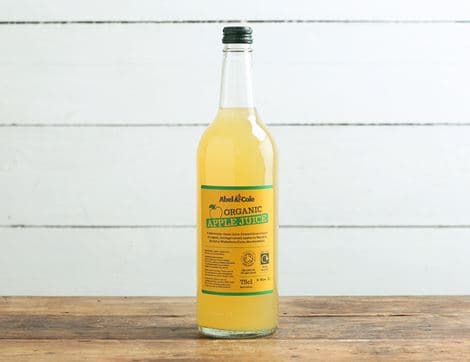
English Apple Juice (75cl)
Abel & Cole
£3.95
(52.7p per 100ml)
Why?
Incredible organic apple juice you just won’t find anywhere else. Made using English heritage apple varieties grown on Whitethorn Farm (home of our berry experts, the Sobles) in Herefordshire, it’s crisp, sweet and utterly refreshing on a warm summer’s day. Pour yourself a glass and start every morning brilliantly. If it’s love at first sip (and we suspect it might be) you’ll even find a handy three pack in our shop too.
Please note, lid colour may vary.
Please note, lid colour may vary.
Read more
Producer
Producer
We’ve been lucky enough to get our apple juice from Rachel and Martin Soble’s gorgeous Whitethorn Farm in the Herefordshire hills. Martin and Rachel like to do things the old-fashioned way, even if they take more time or offer lower yields. “Flavour and quality are what’s important,” Martin says. That’s why they select traditional varieties and lets the sun and soil do the rest of the work.
Nutrition
Nutrition
Nutritional Information per 100g/ml
Energy (kJ): 157
Energy (kcal): 37
Protein (g): 0.1
Carbohydrate (g): 9.7
of which sugars (g): 9.7
Fat (g): 0.0
of which saturates (g): 0.0
Salt (g): 0.0
Energy (kJ): 157
Energy (kcal): 37
Protein (g): 0.1
Carbohydrate (g): 9.7
of which sugars (g): 9.7
Fat (g): 0.0
of which saturates (g): 0.0
Salt (g): 0.0
Ingredients & allergens
Ingredients & allergens
Apple juice*, 0.05% ascorbic acid
*= produced to organic standards
*= produced to organic standards
While we do everything we can to ensure the information on this page is correct, ingredients, nutritional and dietary information are subject to change. So along with the information on our website, we always recommend that you read each label carefully before enjoying your items.
Storage & prep
Storage & prep
Refrigerate after opening and consume within three days. Not suitable for home freezing.
Packaging
Packaging
Food Contact Material: GLASS (Recyclable - Widely recyclable)Lid/Cap: PlasticLabels: plasticContais BPA: No - does not contain BPA